
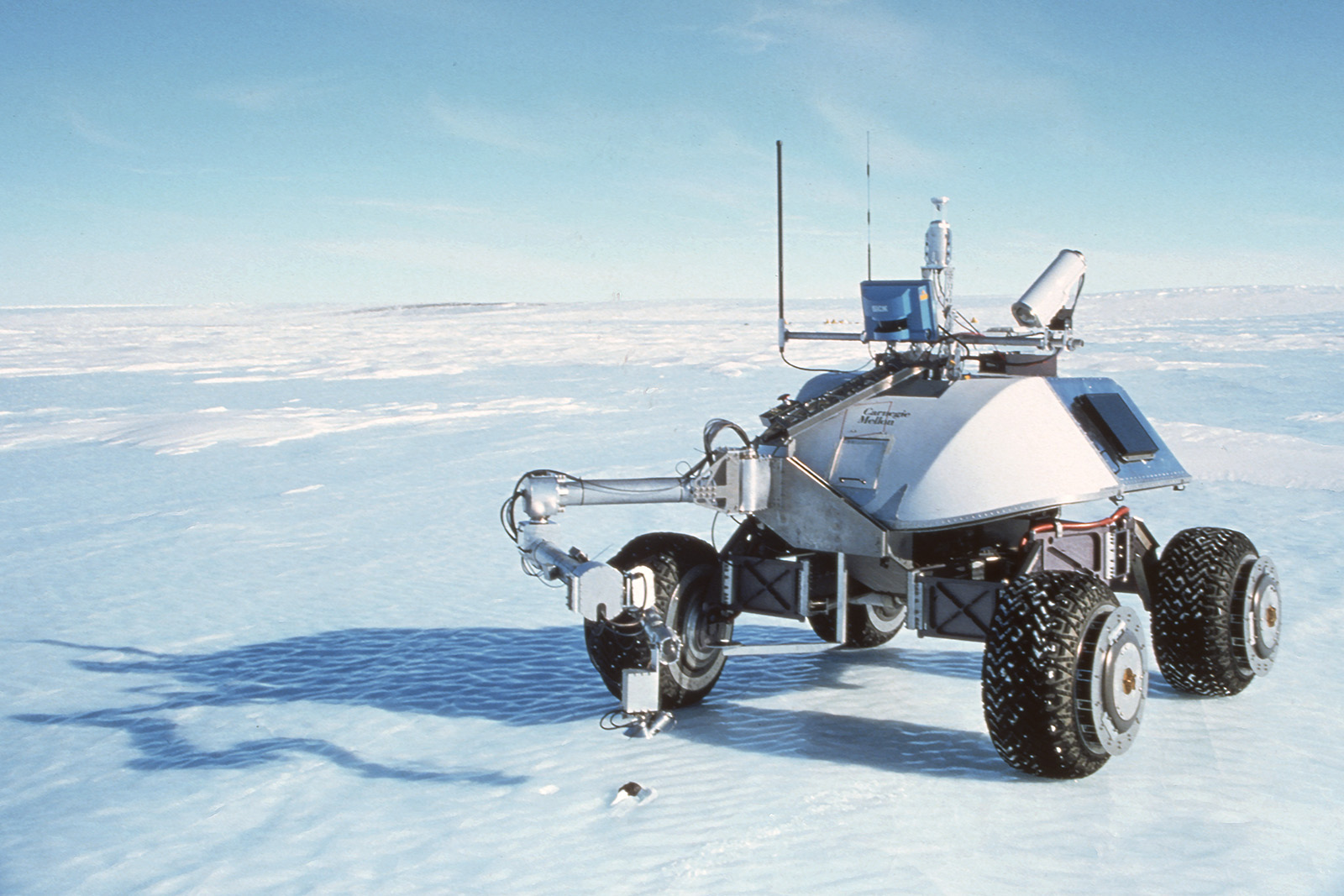
The goals of this program were to develop robots for autonomous search of Antarctic meteorites and demonstrate robotic capability with planetary analogs of environment, control, navigation, communications, and scientific research.
Through tireless investigation in the harsh Antarctic environment and using computer sensing to search above and below the ice surface, meteorobots developed in this program will explore regions of Antarctica to find otherwise undetected meteorites. The use of robots will augment the human search for meteorites by working full-day cycles in the deep cold, and by detecting surface meteorites obscured to the human eye by blowing or drifting snow.
In 2000 this program evaluated the performance of a autonomous mobile robot equipped with meteorite detection sensors at Patriot Hills, an Antarctic site suitable for the proposed deployment and operational challenges. The winterized Nomad will perform autonomous search and navigation excursions, all aiming at evaluating rover gross performance as well as individual subsystems. Moreover, we will field-validate a prototype architecture for detection and classification of native rocks and meteorites.
The goal of this initiative is to enable autonomous discovery of Antarctic meteorites using robotic search and on-site automatic classification of rock samples. In January 2000 the Nomad robot explored the remote Antarctic region of Elephant Moraine in search of new meteorite samples. Nomad autonomously found and classified in situ five indigenous meteorites and dozens of terrestrial rocks. This was an ideal demonstration of robotics in a science mission scenario and environmental challenges similar to exploration of Mars and the Moon. Robotic Search for Antarctic Meteorites accomplishments could impact future missions such as autonomous geology, life seeking and polar exploration.
current head

current staff

current contact

past staff
- Richard Blomquist
- Matthew Deans
- Alex Foessel
- James Frazier
- Michael Montemerlo
- Stewart Moorehead
- Anthony Nolla
- Michael Parris
- Liam Pedersen
- Benjamin Shamah
- Kimberly Shillcutt
- Mark Sibenac
- James Teza
- Nicolas Vandapel
- Vandi Verma
- Michael D Wagner