
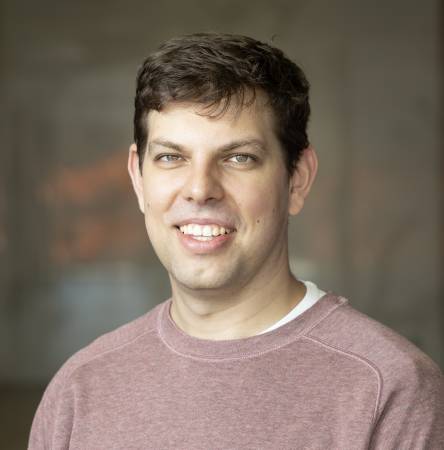
Video Intelligence for Understanding Behavior and Guiding Action
Abstract: Modern video-language models have become remarkably good at describing what is happening in a video. Yet their ability to understand the behavior they observe, and to act on that understanding, remains limited. This talk presents our group's work on building these missing capabilities. I will begin with foundational methods for scalable video perception, from [...]

RI PhD Thesis Proposal – Shashwat Singh
RI CALENDAR EVENT Who: Shashwat Singh Type: RI Thesis Proposal Date: Wednesday, October 7, 2026 Time: 03:30PM - 05:00PM (ET) Location: NSH 4305 Zoom link: Here Title: Extending Robot Mobility Through Mechanical Adaptation Abstract: Unstructured terrain presents diverse challenges to robot locomotion, including obstacles, deformable surfaces, and confined passages. Terrain conditions also change with time, as [...]

RI PhD Speaking Qual – Ryan Schuerkamp
Date: Friday, October 9 Time: 11:30 am – 12:30 pm Room location: GHC 4405 Zoom link: https://cmu.zoom.us/j/9873588831 Title: AdaSoS: Escaping the Exponential Cost of Higher-Order Sum-of-Squares Relaxations Abstract: Many problems in robotics, power systems, and machine learning are nonconvex polynomial optimization problems; local solvers return an answer but cannot tell you how far it is from [...]

RI Faculty Business Meeting
Meeting for RI Faculty. In person location - NSH 4305. Zoom link available via calendar invite.

How Can Robots Learn to Interact and Coordinate with Others?
Abstract: Robots in the real world rarely act alone. They share spaces with other robots and with people, and succeeding there means learning to interact and coordinate with them. This talk looks at what makes interaction hard and how we might get there. I start with multi-agent reinforcement learning, where challenges like credit assignment make coordination [...]


