

2:00 pm to 3:30 pm
Newell-Simon Hall 4305

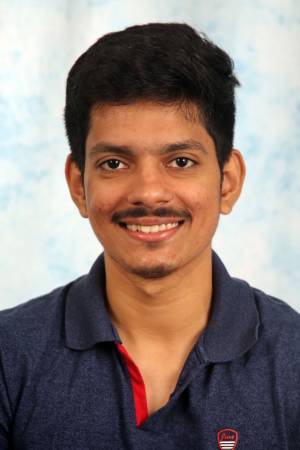
Who: Sriram Narayanan
Type: RI Thesis Proposal
Date: Tuesday, October 27, 2026
Time: 02:00PM – 03:30PM (ET)
Location: NSH 4305
Zoom link: Here
Title: Thermal Computational Imaging through Light and Heat Transport
Abstract:
Computer vision seeks to understand the physical world from images, yet much of this understanding remains rooted in the appearance of reflected visible light. Objects also absorb and emit radiation, exchange heat with their surroundings, and change their temperature over space and time. These processes encode information about materials, geometry, and physical interactions that conventional visible cameras often cannot access. Thermal imaging makes aspects of this energy exchange observable, opening new possibilities for computational imaging.
This dissertation develops a physics-based framework for thermal computational imaging by treating light and heat transport as complementary sources of scene information.
Observations across wavelength and time depend differently on geometry, materials, illumination, and temperature. Connecting these observations through physical models helps distinguish scene properties that remain ambiguous in individual measurements.
We develop this premise through a sequence of inverse problems. Spectral and temporal thermal observations enable separation of radiation emitted by an object from radiation reflected from its surroundings, supporting temperature recovery even when material emissivity is unknown. Next, we show how the thermal consequences of absorbed light complement visible reflection, allowing surface reflectance and shading to be separated without explicitly recovering geometry or lighting. We then establish heat conduction as a geometric cue, recovering three-dimensional shape from the spatial relationships governing temperature evolution across dark, textured, and visibly transparent objects. Combining conduction with shading further allows local shape ambiguities to be resolved through their complementary geometric constraints.
The proposed work extends these connections into thermal simulation within VisionSIM, linking scene illumination, transient heat transport, emitted and reflected radiation, and sensor dynamics to predict thermal observations. Together, the completed and proposed work connect scene reconstruction and image synthesis through the coupled physics of light and heat. They establish energy exchange as both a source of constraints for recovering scene properties and a basis for predicting thermal observations.
Thesis Committee Members:
Srinivasa Narasimhan (Chair)
Aswin Sankaranarayanan
Ioannis Gkioulekas
Ravi Ramamoorthi (UCSD)
Shree Nayar (Columbia)