
Robotics Institute Helps Develop New Capabilities for Servicing Ailing Satellites
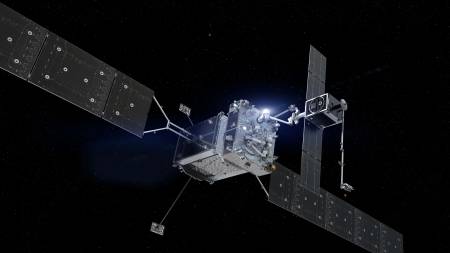
An rendering shows Northrop Grumman’s Mission Robotic Vehicle. (Northrop Grumman)
Placing a peg in a hole is literally child’s play, but when the peg and the hole are more than 22,000 miles above Earth the stakes are much higher.
For Northrop Grumman, perfecting that peg-in-the-hole capability is key to a first-of-its-kind spacecraft designed to refuel and otherwise service satellites in geosynchronous orbit. A Carnegie Mellon University Robotics Institute (RI) team led by professor Howie Choset is providing its expertise to help the company achieve that goal.
Thousands of satellites now orbiting Earth aren’t functional, Choset said, most often because they simply ran out of fuel.
“There’s been this paradigm in aerospace, ‘launch once, use once,’” said Choset, the Kavčić-Moura Professor of Computer Science in the RI. “Now we’re poised to break that paradigm, so a satellite could remain in service indefinitely.”
Northrop Grumman operates several servicing spacecraft. Its most recent and advanced version, the Mission Robotic Vehicle (MRV), launched this past July from Cape Canaveral, Florida.
Andrew Kwas, senior fellow at Northrop Grumman Space, said Choset and his students have been working with the company’s experts to devise a new technique that allows the MRV, which is about the size of a short school bus, to safely approach and dock with another satellite.
“Previously, satellites did not have an easy way to grapple and make a tight connection to allow refueling through a separate port to hold them stable for robotic operations,” Kwas said. “The new technique uses a probe that inserts into the nozzle of the target satellite’s liquid apogee engine to dock the spacecraft together.”
The liquid apogee engine is typically a spacecraft’s main engine.
The analytical and modeling support the Robotics Institute has provided for the new docking procedure has paid off in a big way, Kwas said.
“CMU and Northrop Grumman worked together to assess all contingencies for several years before the first successful mission,” Kwas said about using the new docking system. “Now the process has been repeatedly performed on orbit several times.”
To date, refueling has been the primary use for the servicing spacecraft.
“With the introduction of the MRV, we also have the option to perform repairs, replace parts or perform upgrades in orbit,” Kwas said. “There are many missions that this capability enables. One is the ability to dislodge or repair a solar panel, another failure point on satellites.”
In working with Northrop Grumman engineers on modeling and testing this new approach, Choset drew upon his experience with previous peg-in-the-hole projects in the RI. Aligning a peg with a hole requires not only visual but also touch, or haptic, feedback. It’s a classic challenge in robotics.
Choset is widely known for his work on snake-like robots, such as those his team recently used in Venezuela to look for survivors in the rubble of the June earthquake there.
Years ago, his then-student David Rollinson sought to build ever more sophisticated snakebots and devised a “series elastic actuator,” a motor that can measure the amount of force it applies. Rollinson is now the chief technology officer of HEBI Robotics, a company Choset founded in 2014.
“It’s just like your muscles: When you press on a table, your muscles deliver force, but they also feel the reaction force created by pressing on the table,” Choset said.
In addition to inventing these special actuators, Choset’s group built a robotic testbed, called a holodeck, that uses two robotic arms on a rail to simulate how robots act in the weightlessness of space.
All of this expertise and hardware makes CMU’s Robotics Institute uniquely equipped to tackle the peg-in-hole problem in space.
“They showed us early on that they had the skills to perform the dynamic space operations necessary to refine our design,” Kwas said.
Choset suggested that solving the peg-in-hole problem could have major implications for space operations.
“You solve that and you can assemble structures in space. You can maintain structures in space,” he said.
This capability could unlock the potential to build spacecraft in orbit rather than on Earth, eliminating the need to survive the stresses of launching from Earth, Choset said.
Working with Northrop Grumman for several years has presented Choset with new opportunities, including two Space University Research Initiative grants from the U.S. Space Command. One of the grants supports the work with the company.
For More Information: Aaron Aupperlee | 412-268-9068 | aaupperlee@cmu.edu