

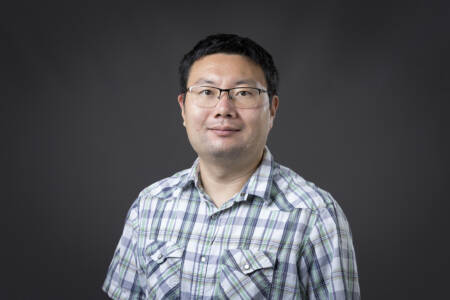
Fuxin Li
Associate Professor
School of Electrical Engineering & Computer Science, Oregon State University
Monday, September 22
3:30 pm to 4:30 pm
Newell-Simon Hall 3305
3:30 pm to 4:30 pm
Newell-Simon Hall 3305
From Sparse to Dense, and Back to Sparse Again?
Abstract: Computer vision architectures used to be built on a sparse sample of points in the 80s and 90s. In the 2000s, dense models started to become popular for visual recognition as heuristically defined sparse models do not cover all the important parts of an image. However, with deep learning and end-to-end training approaches, this does not have to continue and sparse models may still have significant advantages in saving unnecessary computation as well as being more flexible. In this talk, I will talk about point cloud deep learning, how to make it aware of invariances, as well as its diverse applications, such as point cloud segmentation, interaction modeling among objects, point cloud completion and world models for robot manipulation tasks. Point cloud approaches also excel as 2D image recognition backbones. I will introduce our work AutoFocusFormer that uses point cloud backbones and decoders to solve dense 2D prediction tasks such as segmentation, with a novel end-to-end learned adaptive hierarchical downsampling module. This is very helpful for detecting tiny objects faraway in the scene which would have been decimated by conventional grid downsampling approaches. Finally I will introduce some recent work applying AutoFocusFormer for Gaussian splatting semantic SLAM which greatly advanced state-of-the-art.
Bio: Fuxin Li is currently an associate professor in the School of Electrical Engineering and Computer Science at Oregon State University. He has held research positions at Apple Inc., University of Bonn and Georgia Institute of Technology. He had obtained a Ph.D. degree in the Institute of Automation, Chinese Academy of Sciences in 2009. He has won an NSF CAREER award, an Amazon Research Award, CVPR 2024 Best Student Paper runner-up award, (co-)won the PASCAL VOC semantic segmentation challenges from 2009-2012, and led a team to the 4th place finish in the DAVIS Video Segmentation challenge 2017. He is a program chair of CVPR 2025. He has published more than 90 papers in computer vision, machine learning, as well as applications of machine learning and computer vision. His main research interests are point cloud deep networks, human understanding of deep learning, video object segmentation, multi-target tracking and uncertainty estimation in deep learning.
Homepage: Dr. Fuxin Li
Sponsor: The VASC seminar is generously sponsored by HeyGen, an all-in-one AI-powered video generation platform that leverages advances in computer vision, generative modeling, and multimodal learning to make high-quality video creation both scalable and accessible.