
Student-Developed System Wins Award at Farm Robotics Challenge
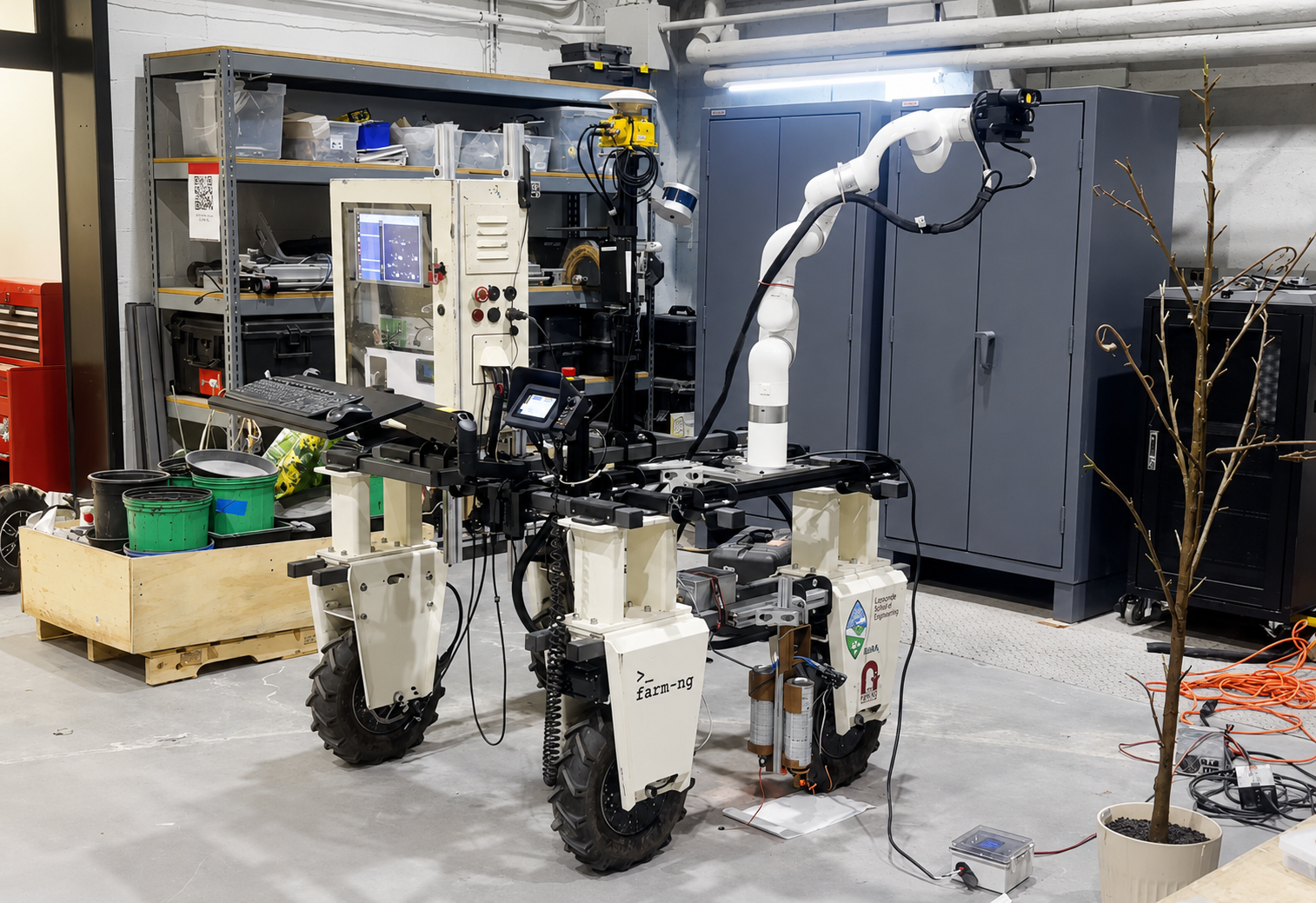
Fire blight can devastate orchards, killing branches and entire trees while causing major economic losses for growers. To help farmers detect the disease earlier and reduce the spread of infection, a team of students from Carnegie Mellon University’s Robotics Institute (RI) developed a robotic solution that recently earned national recognition.
The team, the Fire Blighters, designed an autonomous navigation robot named Erwin that can move through orchard rows, detect fire blight symptoms and map infected trees in real time. The team’s work earned the Amiga Innovation Award at the 2026 Farm Robotics Challenge.
“Erwin helps reduce burdens on workers while collecting detailed data that can benefit growers and consumers alike,” said Hayden Feddock, an RI master’s student and the Fire Blighters team lead. “Our system gives growers a clearer picture of what is happening across their orchards so they can spend less time searching for problems and more time addressing them.”
Fire blight is a bacterial disease that primarily affects fruits in the rose family, most commonly apples, pears and crabapples. The disease causes blossoms, leaves and young shoots to shrivel and turn black. Dead leaves and blossoms remain attached to branches rather than falling off, and entire branches or trees can eventually die if the disease spreads unchecked.
To detect fire blight, Erwin has multiple cameras mounted on a robotic arm that can reach deep into dense foliage. The cameras work in varying lighting conditions to inspect branches — a time-consuming task usually dependent on skilled labor availability. Team members traveled to local orchards to collect images of active fire blight infections and used the data to train a computer vision model to identify signs of the disease in the field.
In conversations with local growers, the students learned that orchard workers often prefer to identify and prune infected branches during the dormant season, when there is less chance of spreading bacteria between trees. The team adapted Erwin’s system to support that workflow, allowing the robot to detect infections, classify them by severity and record their locations in a spatial disease map growers can reference later. Erwin also contains an integrated marking mechanism that can physically tag infected trees with spray paint so pruning crews can quickly locate problem areas.
“We wanted to imitate how a human might search for and detect fire blight in an orchard by walking through each row and closely inspecting every tree,” Feddock said. “We designed the robot to move through the orchard in a similar way. This gives growers more time to focus on orchard management while still providing actionable information about the health of their crops.”
For navigation and safety, the team combined GPS, light detection and ranging technology, and front-facing cameras to guide the robot through orchard rows and detect nearby people or obstacles. If a person enters the robot’s path, Erwin can stop automatically to avoid collisions.
UC ANR Innovate, the innovation arm of the University of California Agriculture and Natural Resources, and the AI Institute for Next Generation Food Systems (AIFS) developed the Farm Robotics Challenge to give college-level students the opportunity to apply robotics technology to real-world agricultural problems. Participants design robotic platforms featuring autonomous navigation, AI and custom attachments to meet common agricultural challenges, including planting crops, controlling weeds and pests, harvesting, and collecting data.
At the competition, the judges praised the Fire Blighters for their integration of robotic navigation and view planning systems, and for the advanced visual interface that allows growers to closely monitor their fields. With these combined technologies, growers can know where and how much intervention is needed to prevent the spread of fire blight.
In addition to a monetary prize, UCANR and AIFS provide travel stipends for participants to attend FIRA USA 2026, which brings together growers, robot manufacturers, researchers, investors, technology builders, and media to accelerate the adoption of autonomous and agricultural technology solutions across the U.S.
The Fire Blighters were advised by RI Systems Scientist Abhisesh Silwal and Senior Project Scientist Francisco Yandun. Along with Feddock, the team included RI master’s students Sandeep Zachariah and Yi Wu; RI undergraduate Jack Nelson; mechanical engineering undergraduate Daniya Nussipbek; and electrical and computer engineering undergraduate Sarthak Jain.
The team collaborated with Mike Allridge, orchard manager at Trax Farms; Kari Anne Peter, associate research professor at Penn State University; and Srđan G. Aćimović, assistant professor at Virginia Polytechnic Institute.
To hear more about the Fire Blighters and their recognition, watch the awards ceremony.
For More Information: Aaron Aupperlee | 412-268-9068 | aaupperlee@cmu.edu