
RI Homepage Carnegie Mellon Homepage RI Homepage

The Robotics Institute

Carnegie Mellon Robotics Institute

Advanced Search   
Courses
  • Course schedules
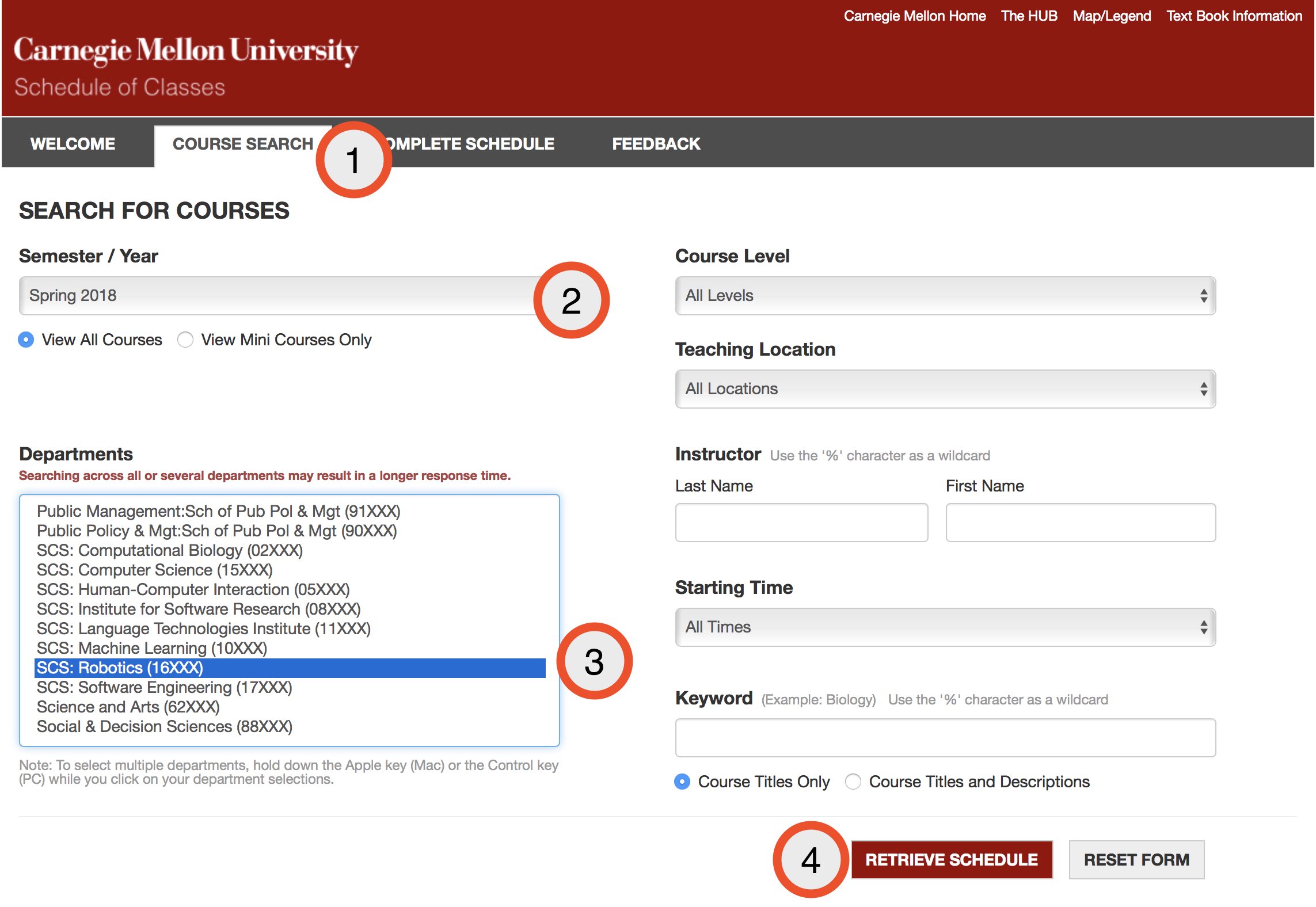
  • The schedule for current and upcoming Robotics courses is maintained at the University level. Choose "Search By Department", and select Robotics.
  • Course numbering
  • All courses with a "16-" prefix are offered by the Robotics Program. Other departments offering courses taught by Robotics faculty are Computer Science (CS), Electrical and Computer Engineering (ECE), Mechanical Engineering (MechE), Statistics (Stat), Psychology (Psych), the Tepper School of Business (GSIA), and the Institute for Complex Engineered Systems (ICES).
  • Robotics courses
  • The following is a list of Robotics courses that are currently offered on a regular basis.
  • 10-701: Machine Learning (CS 15-781)
  • Instructor: Carlos Guestrin
    Units: 12
    Semester: Fall and Spring
    This course is targeted at graduate students who need to learn about current-day research, and about how to perform current-day research, in Artificial Intelligence---the discipline of designing intelligent decision-making machines.
  • Techniques from Probability, Statistics, Economics, Algorithms, Operations Research and Optimal Control are increasingly important tools for improving the intelligence and autonomy of machines, whether those machines are robots surveying Antarctica, schedulers moving billions of dollars of inventory, spacecraft deciding which experiments to perform, or vehicles negotiating for lanes on the freeway. This AI course is a review of a selected set of these tools. The course will cover the ideas underlying these tools, their implementation, and how to use them or extend them in your research.
  • 15-381: Artificial Intelligence: Representation and Problem Solving (CS)
  • Instructors: Martial Hebert, Mike Lewicki
    Units: 12
    Semester: Spring
    This course is about the theory and practice of Artificial Intelligence. We will study modern techniques for computers to represent task-relevant information and make intelligent (i.e. satisficing or optimal) decisions towards the achievement of goals. The search and problem solving methods are applicable throughout a large range of industrial, civil, medical, financial, robotic, and information systems. We will investigate questions about AI systems such as: how to represent knowledge, how to effectively generate appropriate sequences of actions and how to search among alternatives to find optimal or near-optimal solutions. We will also explore how to deal with uncertainty in the world, how to learn from experience, and how to learn decision rules from data. We expect that by the end of the course students will have a thorough understanding of the algorithmic foundations of AI, how probability and AI are closely interrelated, and how automated agents learn. We also expect students to acquire a strong appreciation of the big-picture aspects of developing fully autonomous intelligent agents. Other lectures will introduce additional aspects of AI, including natural language processing, web-based search engines, industrial applications, autonomous robotics, and economic/game-theoretic decision making.
  • Prerequisites: 15211
  • 15-384: Robotic Manipulation (CS)
  • Instructor: George Kantor
    Units: 12
    Semester: Fall
    Foundations and principles of robotic manipulation. Topics include computational models of objects and motion, the mechanics of robotic manipulators, the structure of manipulator control systems, planning and programming of robot actions.
  • Prerequisites: (15-111 or 15-200) and (18-202 or 21-241 or 24-311)
  • 15-385: Computer Vision (CS)
  • Instructors: Srinivasa Narasimhan, Tai-sing Lee
    Units: 12
    Semester: Spring
    Basic concepts in machine vision, including sensing and perception, 2D image analysis, pattern classification, physics-based vision, stereo and motion, and solid model recognition.
  • Prerequisites: 15-213, 21-214, and 21-259
  • 15-462: Computer Graphics I (CS)
  • Instructors: Nancy Pollard, Alexei Efros
    Units: 12
    Semester: Fall
    This course provides a comprehensive introduction to computer graphics modeling, animation, and rendering. Topics covered include basic image processing, geometric transformations, geometric modeling of curves and surfaces, animation, 3-D viewing, visibility algorithms, shading, and ray tracing.
  • Prerequisites: (15-213 and 21-241 and 21-259) or (15-213 and 18-202)
  • 15-491: CMRobotBits: Creating Intelligent Robots (CS)
  • Instructors: Manuela Veloso, Brett Browning
    Units: 9
    Semester: Fall
    Creating intelligent robots can be viewed as the integration of many "bits," "RoboBits," (therefore the name CMRoboBits -- CM for Carnegie Mellon). This course will teach students these "RoboBits" for creating both single robots and groups of intelligent robots. RoboBits achieve the necessary robot capabilities for their perception, cognition, and action. We will use concrete robots, such as the Sony AIBO robots, the ER1s, and other existing robots at CMU, to understand in depth the issues involved in developing such capabilities in a robot and in a group of robots. We will focus on vision processing, object recognition, robot legged and wheeled motion, cognitive architectures, planning, learning, and teamwork among robots and between robot and humans. The course will have a 2h weekly lecture and a 1h weekly recitation/lab session. The course will be primarily hands-on work with weekly homeworks which incrementally build up to the complete robot and robot teams. The homeworks also include a part with questions on the lectured material. There will be a final project, proposed by the students or selected from a list proposed by the instructors, in which the robots perform a complete task. Evaluation will be based on the homeworks, an in-class midterm exam, and the final project.
  • Prerequisites: 15211
  • 15-780: Graduate Artificial Intelligence (CS)
  • Instructors: Ziv Bar-Joseph, Geoff Gordon
    Units: 12
    Semester: Fall
    This course is targeted at graduate students who need to learn about current-day research, and about how to perform current-day research, in Artificial Intelligence---the discipline of designing intelligent decision-making machines.

  • Techniques from Probability, Statistics, Economics, Algorithms, Operations Research and Optimal Control are increasingly important tools for improving the intelligence and autonomy of machines, whether those machines are robots surveying Antarctica, schedulers moving billions of dollars of inventory, spacecraft deciding which experiments to perform, or vehicles negotiating for lanes on the freeway. This AI course is a review of a selected set of these tools. The course will cover the ideas underlying these tools, their implementation, and how to use them or extend them in your research. Please refer to this link for the most recent schedule updates.
  • 15-862: Computational Photography (CS)
  • Instructor: Alexei Efros
    Units: 12
    Semester: Fall
    Computational Photography is an emerging new field created by the convergence of computer graphics, computer vision and photography. Its role is to overcome the limitations of the traditional camera by using computational techniques to produce a richer, more vivid, perhaps more perceptually meaningful representation of our visual world. The aim of this advanced undergraduate course is to study ways in which samples from the real world (images and video) can be used to generate compelling computer graphics imagery. We will learn how to acquire, represent, and render scenes from digitized photographs. Several popular image-based algorithms will be presented, with an emphasis on using these techniques to build practical systems. This hands-on emphasis will be reflected in the programming assignments, in which students will have the opportunity to acquire their own images of indoor and outdoor scenes and develop the image analysis and synthesis tools needed to render and view the scenes on the computer.
  • Prerequisites: 15-213, 21-214, and 21-259
  • 15-883: Computational Models of Neural Systems (CS)
  • Instructor: Dave Touretzky
    Units: 12
    Semester: Fall
    This course is an in-depth study of information processing in real neural systems from a computer science perspective. We will examine several brain areas where processing is sufficiently well understood that it can be discussed in terms of specific representations and algorithms. We will focus primarily on computer models of these systems, after establishing the necessary anatomical, physiological, and psychophysical context. There will be some neuroscience tutorial lectures for those with no prior background in this area.
  • 16-221: Robots to the Rescue: A Gentle Introduction to Mobile Robotics
  • Instructor: Raj Reddy
    Units: 12 or 18
    Semester: Spring, Summer, Fall
  • This course has been designed to teach the basic tools and techniques of engineering and programming a mobile robot. Student teams will build an autonomous mobile robot (from kits that will be provided), and learn to program it to perform increasingly sophisticated behaviors. Besides providing an introduction to autonomous mobile robot technologies, the students also learn key concepts of mechanics, electronics, programming, and systems design and integration. Maybe most important, the students will learn how to use the system for solving interesting and challenging problems in rescue robotics.
  • Programming experience desirable.
  • 16-250: Gadgetry
  • Instructors: Tom Lauwers, Brian Kirby
    Units: 9
    Semester: Spring '10 (Not offered on a regular basis)
  • This course explores the confluence of engineering and design in the context of gadgets: intelligent, interactive electronic devices made from scratch with custom printed circuit boards. Students will learn about circuit board design, microcontroller programming, sensors and actuators, and how to make and evaluate design decisions in the gadgetry space. Students will create several gadgets, with particular attention paid to areas where traditional "dev kit" or "breadboard" prototyping falls short, such as portable, mobile, and miniature devices.
  • 16-264: Humanoids
  • Instructors: Chris Atkeson
    Units: 12
    Semester: Spring '10 (Not offered on a regular basis)
    This course will survey work on humanoid robots and simulated humans in movies, games and other applications. Topics will be taken from perception including visual, auditory, and tactile perception, cognition including reacting, planning, and learning, and movement generation including kinematics, dynamics, control, manipulation, and bipedal locomotion.
  • 16-299: Introduction to Feedback Control Systems
  • Instructor: George Kantor
    Units: 12
    Semester: Spring
    This course is designed as a first course in feedback control systems for computer science majors. Course topics include classical linear control theory (differential equations, Laplace transforms, feedback control), linear state-space methods (controllability/observability, pole placement, LQR), nonlinear systems theory, and an introduction to control using computer learning techniques. Laboratory work includes implementation of controllers robotic devices. Priorities will be given to computer science majors with robotics minor.
  • 16-311: Introduction to Robotics
  • Instructor: Howie Choset
    Units: 12
    Semester: Spring
    This course presents an overview of robotics in practice and research with topics including vision, motion planning, mobile mechanisms, kinematics, inverse kinematics, and sensors. In course projects, students construct robots which are driven by a microcontroller, with each project reinforcing the basic principles developed in lectures. Students nominally work in teams of three: an electrical engineer, a mechanical engineer, and a computer scientist. This course will also expose students to some of the contemporary happenings in robotics, which includes current robot lab research, applications, robot contests and robots in the news.
  • 16-362: Mobile Robot Programming Laboratory
  • Instructor: Al Kelly
    Units: 12
    Semester: Fall
    This course is a comprehensive hands-on introduction to the concepts and basic algorithms needed to make a mobile robot function reliably and effectively. We will work in groups with Nomad Scout robots and interface to them using laptops programmed in the Java programming language in a modern code development environment. This is a lab course with emphasis is on hands-on learning. You will get experience in this course in addition to some theory. Lectures are focussed on the content of the next lab. There is a lab every week and they build on each other so that a complete robot software system results. The course will culminate with a class-wide competition that tests the performance of all of your code implemented in the semester. Typically, your code is at least 5000 lines of Java written jointly with 2 other people. Students must have a 2nd year science/engineering level background in mathematics (matrices, vectors, coordinate systems, basic kinematics) to succeed in the course. Students must have mastered (1 programming course experience) computer programming in a procedure language like C or Java to succeed in the course. The following experience, while not required, will be an asset: a) familiarity with basic computer science data structures and algorithms (equivalent to taking 15-121), b) experience with Eclipse and Subversion or equivalent software development tools, c) experience collaboratively designing and implementing a software system >= 5,000 lines of code.

  • 16-421: Vision Sensors
  • Instructor: Srinivasa Narasimhan
    Units: 12
    Semester: Spring
    This course covers the fundamentals of vision cameras and other sensors - how they function, how they are built, and how to use them effectively. The course presents a journey through the fascinating five-hundered-year history of "camera-making" from the early 1500's "camera obscura" through the advent of film and lenses, to today's mirror-based and solid-state devices. The course includes a significant hands-on component where students learn how to use the sensors and understand, model and deal with the uncertainty (noise) in their measurements. While the first half of the course deals with conventional "single viewpoint" or "perspective" cameras, the second half of the course covers much more recent "multi-viewpoint" or "multi-perspective" cameras that include an array of lenses and mirrors. These sensors provide unusual and compelling forms of visualizations of the world around us that also drive new display technologies.
  • The course is open to all students in SCS and ECE.
  • Prerequisites: Linear Algebra and Calculus.
  • 16-597: Undergraduate Reading and Research
    Need project supervisor's permission.
  • 16-711: Kinematics, Dynamic Systems and Control
  • Instructor: Chris Atkeson
    Units: 12
    Semester: Spring
    Basic concepts and tools for the analysis, design, and control of robotic mechanisms. Topics covered include foundations of kinematics, kinematics of robotic mechanisms, review of basic systems theory, control of dynamical systems. Advanced topics will vary from year-to-year, including motion planning and collision avoidance, adaptive control, and hybrid control.
  • 16-720: Computer Vision
  • Instructor: Martial Hebert
    Units: 12
    Semester: Fall
    This course deals with the science and engineering of computer vision, that is, the analysis of patterns in visual images of the world with the goal of reconstructing and understanding the objects and processes in the world that are producing them. The emphasis is on physical, mathematical, and information processing aspects of vision.
  • Topics covered include image formation and representation, camera geometry and calibration, multi-scale analysis, segmentation, contour and region analysis, energy-based techniques, reconstruction of based on stereo, shading and motion, 3-D surface representation and projection, and analysis and recognition of objects and scenes using statistical and model-based techniques. The material is based on a recent graduate-level textbook augmented with research papers, as appropriate. The course involves considerable Matlab programming exercises.
  • Textbook Information:
    Title: Computer Vision: A Modern Approach
    Authors: David Forsyth and Jean Ponce
    Publisher: Prentice Hall
    ISBN: 0-13-085198-1
  • 16-722: Sensing and Sensors
  • Instructor: Mel Siegel
    Units: 12
    Semester: Spring
    Sensing - the science and art of measurement - and sensors - the devices, instruments, and algorithms that are its tools. First sensing: the things you want to measure, the quantities you actually can measure, when and why it is hard, and the science and engineering you need to succeed. Then sensors: the gadgets you buy and build to put the principles into practice. Select a topic of current interest, for example, biometrics, planetary exploration, or finding improvised explosive devices; research the state of the sensing art in that domain; report your research in a lecture; create corresponding study notes and homework exercises; grade the homework. Your grade will be based on the homework you do, the content and quality of your lecture, the homework assignment you create, and your class participation.
  • No textbook is required for the S2010 edition of 16722; students who would like to own a supplementary text are encouraged to buy Fraden's Handbook of Modern Sensors. Students will be required instead to purchase a USB data acquisition and control module for practical laboratory exercises that are assigned as homework. Details of the specific device -- price comparable to a textbook -- are being negotiated with potential suppliers. Students who would like an update before the first class may email the instructor.
  • 16-725: Methods in Medical Image Analysis
  • Instructor: John Galeotti
    Units: 12
    Semester: Spring (For S '10, class will be held in GHC 4101)
    The fundamentals of computational medical image analysis will be explored, leading to current research in applying geometry and statistics to segmentation, registration, visualization, and image understanding. Student will develop practical experience through projects using the National Library of Medicine Insight Toolkit (ITK), a new software library developed by a consortium of institutions including CMU. In addition to image analysis, the course will describe the major medical imaging modalities and include interaction with practicing radiologists at UPMC.
  • Prerequisites: Knowledge of C++, vector calculus and basic probability. Required textbook, "Machine Vision W/CD, ISBN: 9780521830461; Optional textbook, "Insight to Images", ISBN: 9781568812175.
  • 16-735: Robotic Motion Planning
  • Instructor: Howie Choset
    Units: 12
    Semester: (not offered on a regular basis)
    The robot motion field and its applications have become incredibly broad and theoretically deep at the same time. The goal of the course is to provide an up-to-date foundation in the motion planning field, make the fundamentals of motion planning accessible to the novice and relate low-level implementation to high-level algorithmic concepts. We cover basic path planning algorithms using potential functions, roadmaps and cellular decompositions. We also look at the recent advances in sensor-based implementation and probabalistic techniques, including sample-based roadmaps, rapidly exploring random trees, Kalman filtering, and Bayesian estimation.
  • 16-741: Mechanics of Manipulation
  • Instructor: Matt Mason
    Units: 12
    Semester: Spring
    Kinematics, statics, and dynamics of robotic manipulator's interaction with a task, focusing on intelligent use of kinematic constraint, gravity, and frictional forces. Automatic planning based on mechanics. Application examples drawn from manufacturing and other domains.
  • 16-761: Introduction to Mobile Robots
  • Instructor: Al Kelly
    Units: 12
    Semester: Spring
    This course covers all aspects of mobile robot systems design and programming from both a theoretical and a practical perspective. The basic subsystems of control, localization, mapping, perception, and planning are presented. For each, the discussion will include relevant methods from applied mathematics. aspects of physics necessary in the construction of models of system and environmental behavior, and core algorithms which have proven to be valuable in a wide range of circumstances.
  • 16-764: Ethnography: Analyzing How Context Affects Technology Use
  • Instructors: Aaron Steinfeld, Diane Collins (PITT)
    Units: 12
    Semester: Fall
    Ethnography is a scientific process for describing people and cultures. This immersive course teaches and demonstrates ethnographic methods for understanding the end users for which new technology will be deployed. These include fieldwork, passive and active observation, secondary analyses, and novel computer-assisted approaches. This class will help students characterize and understand the practices, preferences, and needs of end users, the surrounding environment, and the associated societal factors that will affect technology success. The class will emphasize Quality of Life Technologies for people with disabilities and older adults but the methods learned are applicable to any domain where humans and systems interact. Students will work in teams to use the ethnographic methods taught in class to convey the constraints and opportunities for a target technological application.
  • 16-778: Mechatronic Design (also ECE 18-578)
  • Instructor: John Dolan
    Units: 12
    Semester: Spring
    Mechatronics is the synergistic integration of mechanism, electronics, and computer control to achieve a functional system. Because of the emphasis upon integration, this course is a semester-long multidisciplinary capstone hardware project design experience in which small teams of electrical and computer engineering, mechanical engineering and robotic students deliver an end-of-course demonstration of a final integrated prototypical system. Throughout the semester, the students configure, design, implement, test and evaluate in the laboratory several mechatronic devices and subsystems culminating in the final integrated system.
  • Lectures will complement the laboratory experience with comparative surveys, operational principles, and integrated design issues associated with the spectrum of mechanism, electronics, and control components.
  • 16-811: Mathematical Fundamentals for Robotics
  • Instructor: Michael Erdmann
    Units: 12
    Semester: Fall
    This course covers selected topics in applied mathematics useful in robotics, taken from the following list: 1. Solution of Linear Equations. 2. Polynomial Interpolation and Approximation. 3. Solution of Nonlinear Equations. 4. Roots of Polynomials, Resultants. 5. Approximation by Orthogonal Functions (includes Fourier series). 6. Integration of Ordinary Differential Equations. 7. Optimization. 8. Calculus of Variations (with applications to Mechanics). 9. Probability and Stochastic Processes (Markov chains). 10. Computational Geometry. 11. Differential Geometry.
  • 16-822: Geometry-based Methods in Vision
  • Instructor: Martial Hebert
    Units: 12
    Semester: Spring
    The course focuses on the geometric aspects of computer vision: the geometry of image formation and its use for 3D reconstruction and calibration. The objective of the course is to introduce the formal tools and results that are necessary for developing multi-view reconstruction algorithms. The fundamental tools introduced study affine and projective geometry, which are essential to the development of image formation models. Additional algebraic tools, such as exterior algebras are also introduced at the beginning of the course. These tools are then used to develop formal models of geometric image formation for a single view (camera model), two views (fundamental matrix), and three views (trifocal tensor); 3D reconstruction from multiple images; and auto-calibration.
  • Prerequisites: Computer Vision (16-721 or equivalent)
  • Book: The Geometry of Multiple Images, Faugeras and Long, MIT Press.
  • Topics covered:
    • Fundamentals of projective, affine, and Euclidean geometries
    • Invariance and duality
    • Exterior and Grassman algebras
    • Single view geometry: The pinhole model
    • Calibration techniques
    • 2-view geometry: The Fundamental matrix
    • 2-view reconstruction
    • 3-view geometry: The trifocal tensor
    • Parameter estimation and uncertainty
    • n-view reconstruction
    • Self-calibration
  • 16-823: Physics based Methods in Computer Vision
  • Instructor: Srinivasa Narasimhan
    Units: 12
    Semester: Fall
    Everyday we observe an extraordinary array of light and color phenomena around us, ranging from the dazzling effects of the atmosphere, the complex appearances of surfaces and materials and underwater scenarios. For a long time, artists, scientists and photographers have been fascinated by these effects, and have focused their attention on capturing and understanding these phenomena. In this course, we take a computational approach to modeling and analyzing these phenomena, which we collectively call as "visual appearance". The first half of the course focuses on the physical fundamentals of visual appearance, while the second half of the course focuses on algorithms and applications in a variety of fields such as computer vision, graphics and remote sensing and technologies such as underwater and aerial imaging. This course unifies concepts usually learnt in physical sciences and their application in imaging sciences. The course will also include a photography competition in addition to analytical and practical assignments.
  • Prerequisites: Linear algebra, Calculus, Undergraduate Vision, Graphics, or Image processing or equivalent course
  • 16-824: Physics-based Methods in Vision
  • Instructor: Martial Hebert
    Units: 12
    Semester: Spring
    A graduate seminar course in Computer Vision with emphasis on using large amounts of real data (images, video, textual annotations, user preferences, etc) to learn the structure of our visual world toward the ultimate goal of Image Understanding. We will be reading an eclectic mix of classic and recent papers on topics including: theories of perception, low-level vision (color, texture), mid-level vision (grouping and segmentation), object and scene recognition, image parsing, words and pictures models, image manifolds, etc.
  • Prerequisites: Graduate Computer Vision
  • 16-830: Planning, Execution and Learning (also CS 15-887)
  • Instructors: Reid Simmons, Manuela Veloso
    Units: 12
    Semester: (not offered on a regular basis)
    This course will explore both classical and modern approaches to planning. Issues to be discussed include: how to represent actions and world state, how to search for plans efficiently, how to deal with uncertainty in actions and the world state, how to represent time, and how to dynamically combine planning and execution.
  • Specific planning techniques to be covered include: means-ends analysis, linear and non-linear planning, GraphPlan, SatPlan, hierarchical planning, conditional planning, probabilistic planning using Markov models (MDPs and POMDPs), integration of planning, perception and execution, execution monitoring and replanning, planning and learning, and robot (geometric) planning. There are no explicit prerequisites, but a basic knowledge of AI is assumed.
  • 16-831: Statistical Techniques in Robotics
  • Instructor: Drew Bagnell
    Units: 12
    Semester: Fall
    Probabilistic and learning techniques are now an essential part of building robots (or embedded systems) designed to operate in the real world. These systems must deal with uncertainty and adapt to changes in the environment by learning from experience. Uncertainty arises from many sources: the inherent limitations in our ability to model the world, noise and perceptual limitations in sensor measurements, and the approximate nature of algorithmic solutions. Building intelligent machines also requires that they adapt to their environment. Few things are more frustrating than machines that repeat the same mistake over and over again. We'll explore modern learning techniques that are effective at learning online: i.e. throughout the robots operation. We'll also explore how the twin ideas of uncertainty and adaptation are closely tied in both theory and implementation.
  • 16-850: Systems Engineering
  • Instructors: Illah Nourbakhsh, David Wettergreen
    Units: 12
    Semester: Spring
    Systems Engineering is a multidisciplinary approach and means of creating complex devices and systems. It recognizes that hardware and software and the operating environment are interrelated in the process of creating complex systems. How do we trade off hardware "apples" and software "oranges"? What methods and tools can we apply to help make wise decisions? To create effective systems we must recognize and consider many perspectives, issues, and disciplines simultaneously.
  • In this course our focus is on systems of hardware and software components engineered to perform complex behavior. Such systems embed computing elements, integrate sensors and actuators, operate in a reliable and timely fashion, and demand rigorous engineering from conception through production. Applications of robotics technology will be used to illustrate applications and the challenges in engineering complex systems.
  • Concepts, problems, and methods of systems engineering are introduced and discussed in lectures and developed in assignments. Case studies and guest lectures present best practice in the field. Readings from current literature will tie theory to practical methods of creating complex devices.
  • Students gain practical experience through a highly-structured small group project that will run the entire semester. We will progress through systems engineering processes of analysis, design, implementation, and deployment with parallel consideration of testing and evaluation. Past projects have used the Pittsburgh Children's Museum as context where we have collaborated to create and deploy interactive exhibits within the museum.
  • This course should be appropriate for graduate students in engineering, sciences and design and for advanced undergraduates with the permission of the instructor. Class size will be limited.
  • 16-861: Mobile Robot Design
  • Instructor: Red Whittaker
    Units: 12
    Semester: Fall
    The Fall 2005 offering of 16-861, Mobile Robot Design, will develop, evaluate and document robot and route planning capabilities for driverless desert racing. The class will operate as a team to compete in a 300-kilometer challenge of autonomous technology for a $2M prize and the opportunity to make history. Participants will analyze race performance results and publish technical findings.
  • 16-865: Advanced Mobile Robot Development
  • Instructor: Red Whittaker
    Units: 12
    Semester: Spring
    This course investigates the synergies of robot mobility, energetics, sensing, computing, software, payload and operating environment. These are modeled in simulation, then implemented and evaluated as components, and ultimately integrated into, and tested as, a comprehensive, tangible, robot prototype.
  • The topical context for spring 2007 is robotic pursuit of the Google Lunar X-Prize. The prize calls for HDTV mooncast of a half-kilometer trek after soft-landing on the moon. The course will prototype a robotic spacecraft for this challenge.
  • Sub-disciplines will include landing, locomotion, navigation, communication, sensing, power and thermal. Systems engineering will consider X-Prize requirements in addition to the traditional challenges of low mass, low power, thermal extreme, radiation and extreme reliability of space robot design.
  • Requirements for the X-Prize include production of a mooncast and visualization of the mission in addition to the lunar landing and surface mission, so the course will be appropriate for a broad range of students and interests.
  • 16-871: Technology for Developing Communities
  • Instructors: Rahul Tongia & Bernardine Dias
    Units: 12
    Semester: Fall
    This graduate course studies meaningful ways to use advanced technologies to support developing communities worldwide. It focuses on communities that include the poorest 4 billion people: people who today lack access to modern technologies and infrastructure. We focus on the broad space of computing, information and communications technologies which include robotics, sensor networks, etc.
  • The course provides an overview of social and economic aspects of development as well as technologies in the context of development. A key goal is examination of advanced technologies as applicable to sustainable development.
  • Because of the nature of the subject, this course will be broad and interdisciplinary. It will cover the basics of technology, economics, and policy, and we expect students to explore specific areas of interest in depth on their own (from either a technical, policy, or interdisciplinary perspective). Each student will carry out a project of the student's design, working individually on in small groups. Example topics for student projects have included: participatory GIS for empowerment, critique of the $100 Laptop, developing a computer-based English literacy tutor for Ghana, and a cost-benefit analysis of pre-paid metering for water in developing countries.
  • This course has no prerequisites, and is open graduate students in all disciplines. There will be no final exam, and the project will make a significant portion of the grade. This class has been taught several times previously (under slightly different names) and students have gone on to publish their project work or expanded it into further research.
  • 16-899A: Hands: Design and Control for Dexterous Manipulation
  • Instructor: Nancy Pollard
    Units: 12
    Semester: Spring '10 (Not offered on a regular basis)
    In this course, we will survey robotic hands and learn about the human hand with the goal of understanding hand design and control for dexterity. Questions to be explored include the following. Should robot hand kinematics be humanlike? What robotic sensors are available practical, how do they measure up to sensors.
  • in the human hand, and what sensing capabilities are required for dexterous manipulation? What is a good benchmark suite of tasks for evaluating dexterous behavior? How do we design control algorithms for dexterous manipulation in the presence of uncertainty? What can we learn from human manipulation performance to improve robotic manipulation capability? This is a reading and project course. Students will be asked to present one or two short research papers of their own and to design and carry out a final project.
  • 16-899 C: Adaptive Control and Reinforcement Learning
  • Instructor: Drew Bagnell
    Units: 12
    Semester: Spring '10
    Machine learning has escaped from the cage of perception. A growing number of state-of-the-art systems from field robotics, acrobatic autonomous helicopters, to the leading computer Go player and walking robots rely upon learning techniques to make decisions. This change represents a truly fundamental departure from traditional classification and regression methods as such learning systems must cope with a) their own effects on the world, b) sequential decision making and long control horizons, and c) the exploration and exploitation trade-off. In the last 5 years, techniques and understanding of these have developed dramatically. One key to the advance of learning methods has been a tight integration with optimization techniques, and as such our case studies will focus on this.
  • 16-899D: Principles of Human-Robot Interaction
  • Instructor: Illah Nourbakhsh
    Units: 12
    Semester: Fall
    This course focuses on the emerging field of human-robot interaction, bringing together research and application of methodology from robotics, human factors, human-computer interaction, interaction design, cognitive psychology, education and other fields to enable robots to have more natural and more rewarding interactions with humans throughout their spheres of functioning. This course is a combination of state-of-art reading and discussions, focused team exercises and problem-solving sessions in human-robot interaction, and a special team project resulting in the implementation of a human-robot interaction system.
  • This new area of inquiry brings together diverse areas of expertise, and so this course includes some guest lectures by researchers in human factors and in education/psychology (University of Pittsburgh) as well as design, human-computer interaction, drama and robotics (Carnegie Mellon University).
  • 16-899E: Legged Locomotion
  • Instructor: Chris Atkeson
    Units: 12
    Semester: Spring
    This IGERT / QoLT course explores the principles and practicalities of legged locomotion (both biped and quadruped). We will focus on developing control algorithms for a human-sized bipedal robot and for a small quadruped robot "Little Dog". There will be a mix of lectures given by the instructor and presentations by participants. Participants will read and present key papers, explore research issues in simulation, and ideally test ideas on actual robots. We are also interested in insights into human locomotion and how to program graphical characters.
  • 16-995: Independent Study For Robotics graduate students only.
  • 16-997: Reading and Research For Robotics graduate students only.