Mobile Robots
Research in mobile robots has remained one of the main components of RI since its inception. Today, it continues to be a key strength of the RI, with over 20 faculty members affiliated with mobile robot research. All the major research topics in mobile robotics are being addressed in the RI, ranging from locomotion issues in small-size robots with innovative designs (Choset, Hollis), to robots for exploration (Dolan, Wettergreen, Whittaker), to large systems for outdoor navigation (Bares, Kelly, Stentz). An important development that is continuing to take place is the integration of basic research components, such as statistical learning (Bagnell), into large projects that were traditionally oriented toward systems development.
A first broad research theme is the development of planning and architectural tools for mobile robots. Kelly and Stentz have developed comprehensive approaches that have been demonstrated on both indoor and outdoor systems and integrated in field systems. Products of this research have been transferred to NASA and to DoD applications. This work has evolved from the development of core planning tools to algorithms that incorporate coverage mapping, uncertain robot localization and higher-level behaviors. Trajectory and path planning tools developed in the space robotics context were adapted for highly successful use in the 2007 Urban Challenge autonomous driving competition.
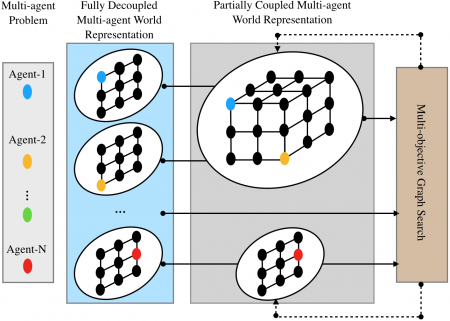
A second broad research theme is localization and mapping, in which new techniques are being developed for image-based localization (Singh, Choset) and for map registration (Hebert). A third broad direction is the development of techniques for multi-robot cooperation. This area, closely tied with more general research in multi-agent systems (see separate section), has led to the development of algorithms for controlling teams of robots to execute complex tasks, such as exploration and area surveillance.
Research in mobile robots is also tightly connected with research in human robot interaction (e.g., Nourbakhsh, Simmons). Part of this research has led to interesting transfers to outreach activities, such as the Personal Rover Project (Nourbakhsh) in which systems that can be used in the home, school, or local science museums are developed. Results from that project have led to considerable exposure in the nation's science museums.
The RI has also developed a strong component in the area of aerial robots. This activity started primarily with Amidi's work on autonomous helicopters. This work has led to the development of complete systems for autonomous flight and mapping. These developments have subsequently motivated new research in GPS-less flying (Singh) and high-precision mapping (Amidi, Kanade). More recently, the research has been extended to multiple cooperating flying vehicles and to cooperation between air and ground robots (see sections on Multi-Agent Systems and Field Robots).
Results in the mobile robots area have been instrumental in supporting the development of a number of systems in a variety of applications (described also in the Field Robots section). Applications include robots for space exploration; outdoor robots navigating in unstructured terrain for agriculture, defense, construction, search and rescue, and surface and underwater aquatic applications; and intelligent vehicles for driver assistance in urban environments.
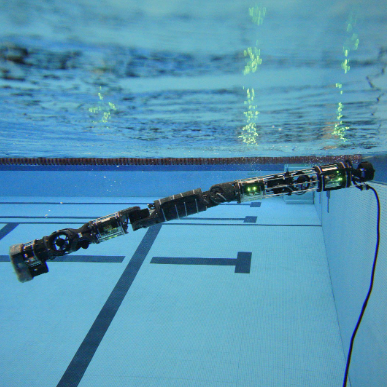
Many of these application arenas have also required the development of unique mobility devices, stretching the inventiveness of mechanisms-designers and –integrators. Interesting outgrowths of these efforts at RI include the BallBot (Hollis; Balancing Transporter), Scarab/Hyperion/RATS (Wettergreen, Apostolopoulos; Planetary Exploration), Explorer (Schempf; Pipeline Inspection), Gladiator/Crusher/Dragon Runner (Apostolopoulos, Bares, Schempf; Military Reconnaissance), SnakeBots (Choset; Assembly/Inspection/Medical Systems), and RSB (Dolan; Maritime Sampling) over the last 6 years (2005-2010).
Table of Contents
Faculty
Video
-
Scarab: Discovery Channel
-
Crusher
-
Grand Challenge: Highlander
-
Marine Robotics
-
Urban Grand Challenge: Boss: Highlights
Publications
-
DragonRunner
-
Explorer: Untethered Real-Time Gas Main Assessment RobotSystem
-
Avoiding Collisions Between Aircraft
-
Perceptual Interpretation for Autonomous Navigation through Dynamic Imitation Learning
-
Autonomous Driving in Urban Environments: Boss and the Urban Challenge
-
Toward Reliable Off Road Autonomous Vehicles Operating in Challenging Environments
-
Design and field experimentation of a prototype Lunar prospector
-
A Robust Approach to High-Speed Navigation for Unrehearsed Desert Terrain
-
Autonomous Driving in Urban Environments: Boss and the Urban Challenge
-
Crusher
Web
-
Gladiator/TUGV Videos
-
ModSnake Website
-
Aircraft Laser Paint Removal
-
Autonomous Haulage System (AHS)
-
DragonRunner Photos
-
DragonRunner Videos
-
Sense & Avoid
-
Orchard Sprayer
-
Tartan Racing: Urban Driving
-
UGCV/UPI
-
Boss Gallery
-
SACR Videos
-
Autonomous Navigation System (ANS) Photos
-
Crusher Videos
-
Sense and Avoid for Unmanned Aerial Vehicles
-
UPI Videos
-
Wired Magazine Rides in Boss at CES2008